
Addressing Challenges of AI in the Job Search: Overcoming Bias and Enhancing Human Connection
The integration of artificial intelligence (AI) into the job search process has transformed how candidates and employers interact. However, this technological advancement comes with significant challenges, particularly concerning bias and the erosion of human connection. In this article, we will explore the various ways AI impacts job seekers, the biases inherent in AI recruitment systems, and strategies to navigate these challenges effectively. By understanding these dynamics, job seekers can better position themselves in an increasingly automated hiring landscape. We will delve into the types of biases present in AI systems, the main challenges of AI in recruitment, and how candidates can overcome AI filters while emphasizing the importance of human judgment in hiring decisions.
The increasing deployment of AI in recruitment, while efficient, also raises significant ethical questions that demand careful consideration.
Ethical Concerns in AI-Enabled Recruitment & Selection
Companies increasingly deploy artificial intelligence (AI) technologies in their personnel recruiting and selection process to streamline it, making it faster and more efficient. AI applications can be found in various stages of recruiting, such as writing job ads, screening of applicant resumes, and analyzing video interviews via face recognition software. As these new technologies significantly impact people’s lives and careers but often trigger ethical concerns, the ethicality of these AI applications needs to be comprehensively understood.
Ethics of AI-enabled recruiting and selection: A review and research agenda, C Luetge, 2022
How does AI hiring bias affect job seekers today?
AI hiring bias refers to the systematic favoritism that can occur when algorithms are used to screen candidates. This bias can manifest in various ways, often disadvantaging certain groups of applicants based on gender, race, or other characteristics. Research indicates that AI systems can perpetuate existing biases found in historical hiring data, leading to skewed outcomes that affect diverse candidates disproportionately. Understanding the implications of AI bias is crucial for job seekers navigating this complex landscape.
What types of biases are common in AI recruitment systems?
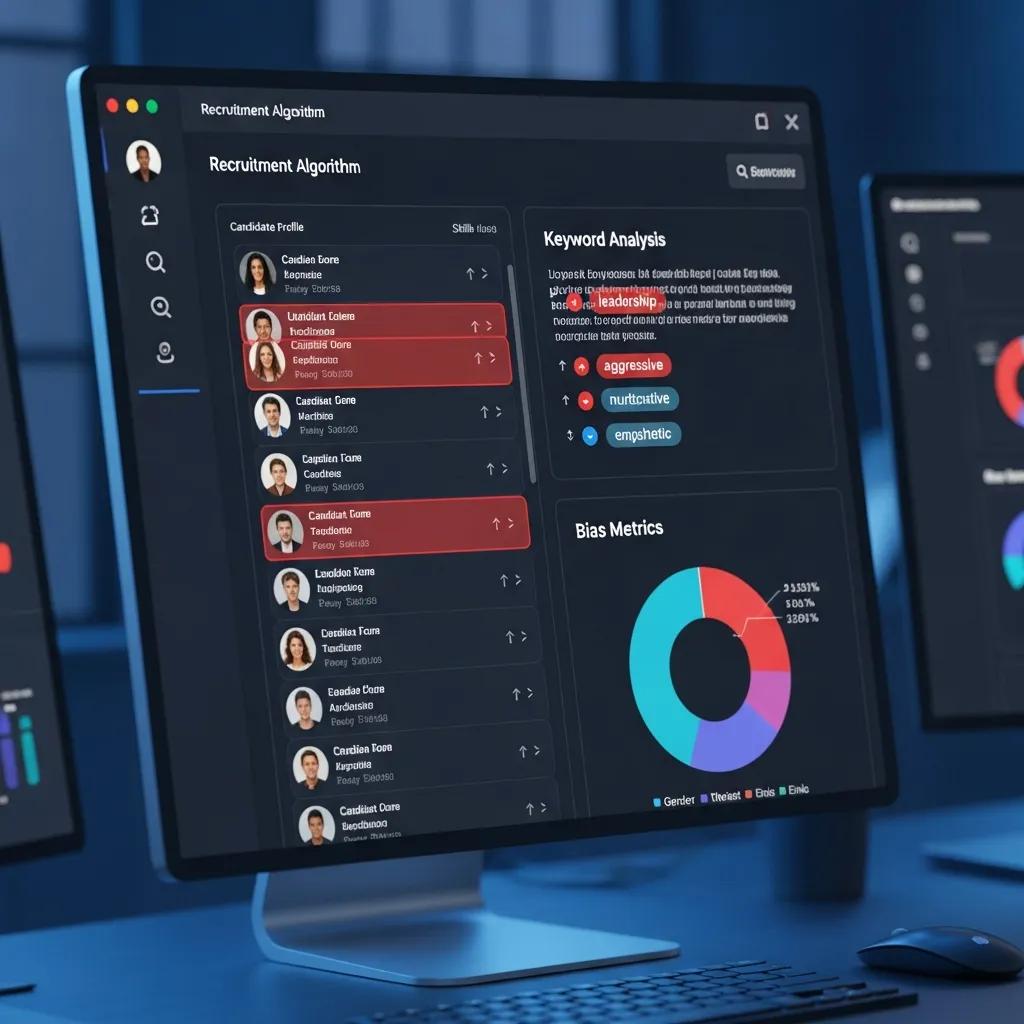
Common biases in AI recruitment systems include gender bias, racial bias, and age bias. For instance, algorithms trained on historical hiring data may favor candidates who fit a specific demographic profile, often overlooking qualified individuals from underrepresented groups. Studies have shown that certain algorithms can inadvertently prioritize resumes that match traditional norms, thereby disadvantaging innovative candidates who may not conform to these standards.
Addressing these inherent biases is critical, and research suggests that explainable AI (XAI) approaches can play a vital role in mitigating discrimination in hiring decisions.
Mitigating AI Bias & Discrimination in Hiring with XAI
Assuming that potential biases of Artificial Intelligence (AI)-based systems can be identified and controlled for (e.g., by providing high quality training data), employing such systems to augment human resource (HR)-decision makers in candidate selection provides an opportunity to make selection processes more objective. However, as the final hiring decision is likely to remain with humans, prevalent human biases could still cause discrimination. This work investigates the impact of an AI-based system’s candidate recommendations on humans’ hiring decisions and how this relation could be moderated by an Explainable AI (XAI) approach.
Applying XAI to an AI-based system for candidate management to mitigate bias and discrimination in hiring, L Hofeditz, 2022
How do biased AI filters impact diverse candidates?
Biased AI filters can significantly impact diverse candidates by limiting their opportunities for employment. Research reveals that companies using biased algorithms may see a decrease in diversity within their workforce, as these systems often filter out applicants who do not fit the established mold. Personal stories from affected candidates highlight the long-term effects of such biases, including reduced workplace diversity and the perpetuation of inequality in hiring practices.
What are the main challenges of AI in recruitment processes?
The challenges posed by AI in recruitment processes are multifaceted. While AI can streamline hiring, it can also lead to the exclusion of qualified applicants due to algorithmic limitations. Understanding these challenges is essential for both job seekers and employers aiming to create a fair hiring environment.
Why do AI recruitment tools sometimes overlook qualified applicants?
AI recruitment tools may overlook qualified applicants due to common algorithmic errors, such as over-reliance on specific keywords or criteria that do not accurately reflect a candidate’s potential. For example, an applicant with relevant experience but a non-traditional career path may be filtered out simply because their resume does not match the conventional format expected by the AI system.
This oversight can lead to a loss of talent and innovation in the hiring process.
How can AI filters create barriers in the job search?
AI filters can create various barriers in the job search, including technical and psychological obstacles. Technical barriers arise when candidates are unable to navigate complex application systems or when their resumes are not formatted in a way that AI can easily interpret. Psychological barriers may include the discouragement candidates feel when they perceive that their applications are unlikely to succeed due to automated screening processes. These barriers can deter qualified individuals from applying, further exacerbating the challenges of diversity in hiring.
How can job seekers overcome AI filters in the AI era?
Job seekers can adopt several strategies to navigate AI filters effectively. By understanding how these systems work, candidates can enhance their chances of being noticed by potential employers.
What strategies help bypass automated screening systems?
To bypass automated screening systems, job seekers should focus on optimizing their resumes and leveraging networking opportunities. Networking can provide valuable connections that may help candidates bypass initial AI screenings. Additionally, tailoring resumes to include relevant keywords and phrases that align with job descriptions can improve visibility in automated systems.
How to optimize resumes and profiles for AI recruitment?
Optimizing resumes for AI recruitment involves several best practices. Candidates should ensure their resumes are formatted clearly, using standard headings and bullet points to enhance readability. Incorporating industry-specific keywords and phrases can also help align a candidate’s profile with the job requirements. Common mistakes to avoid include using overly complex language or unconventional formats that may confuse AI systems.
Why is the human element crucial in AI hiring decisions?

While AI can enhance efficiency in hiring, the human element remains crucial for making fair and informed decisions. Employers must balance the benefits of AI with the need for human judgment to ensure a comprehensive evaluation of candidates.
How can employers balance AI efficiency with human judgment?
Employers can balance AI efficiency with human judgment by implementing hybrid hiring processes that combine automated screening with human oversight. This approach allows for the initial filtering of candidates through AI while ensuring that qualified individuals are reviewed by hiring managers. Best practices include regular audits of AI systems to identify and mitigate biases, ensuring a fairer hiring process.
This integrated approach, combining the strengths of AI and human insight, is increasingly recognized as a key strategy for optimizing recruitment processes.
Hybrid AI-Human Recruitment for Enhanced Hiring
A key contribution of this paper is the conceptualization of a hybrid AI–human recruitment model, which integrates the strengths of both artificial intelligence and human decision-making. By adopting such hybrid workflows, organizations can leverage AI for efficient data processing and initial screening, while reserving human insight for nuanced evaluations, interpersonal interactions, and complex decision-making, thereby optimizing recruitment processes.
AUTOMATION IN RECRUITMENT: BALANCING AI AND HUMAN INSIGHT FOR BETTER HIRING DECISIONS
What role does empathy play in fair AI-driven hiring?
Empathy plays a significant role in fair AI-driven hiring by fostering a more inclusive and understanding approach to candidate evaluation. Employers who prioritize empathetic hiring practices can create a more welcoming environment for diverse candidates. By recognizing the limitations of AI and valuing human insights, organizations can enhance the candidate experience and promote a more equitable hiring process.
