How to Answer "Tell Me About Yourself" in a Job Interview (The Complete 2026 Guide)
Every job interview starts the same way.
You sit down. The hiring manager smiles and clicks open their laptop. There is a brief moment of small talk about the commute or the weather. And then they look up and say it.
"So — tell me about yourself."
It sounds like an invitation to relax. It is not. This is the most loaded question in the entire interview, and the way you answer it in the next 90 seconds sets the tone for everything that follows. It determines whether the interviewer leans in or mentally checks out. It signals whether you are a candidate who knows how to communicate under pressure or someone who is about to ramble through their entire work history and hope something sticks.
This is also the most searched interview question on the internet. Over 756,000 people search for help answering it every year in the UK alone. Multiply that by four or five for the United States. Add every other English-speaking market and the number gets staggering. Everyone faces this question. Almost no one prepares for it the right way.
This guide walks you through exactly how to answer it — across every career stage, for every interview format, with real examples you can adapt and a practice system that will make the answer second nature before your next interview.
Why "Tell Me About Yourself" Is Harder Than It Looks
The reason this question catches so many candidates off guard is that it feels casual. There is no job description language to mirror back. There is no obvious right or wrong answer. It does not look like a test, so people do not treat it like one.
But the interviewer is absolutely testing you.
They are not asking because they want to know about your childhood or hear you recap your resume out loud. They already have your resume. They read it before you walked in. What they are actually evaluating in those first 90 seconds is a set of very specific things.
First, can you communicate with clarity and structure when the frame is loose? Plenty of people can answer precise questions about their work experience. Far fewer can synthesize that experience into a concise, compelling narrative without a specific prompt guiding them.
Second, do you understand what this role actually needs, and can you immediately connect your background to it? A candidate who answers this question with a pitch tailored to the specific company signals that they have done their research and that they know how to align their strengths with what the job requires. That is rare and it is noticed.
Third, are you confident without being arrogant? The tone of your answer tells the interviewer a great deal about your self-awareness and your presence. Candidates who answer in a calm, structured, specific way almost always come across as more senior than their title suggests.
Fourth, what kind of storyteller are you? Every high-performing professional needs to be able to tell the story of their own career in a way that makes sense to someone who knows nothing about them.
This question is that test.
A bad answer is a life story. A good answer is a pitch. The difference is preparation.
The Most Common Mistakes Candidates Make
Before getting into what works, it helps to understand what does not, because most people make the same handful of mistakes and do not realize it until they are out of the building thinking about what they should have said.
Starting from the beginning. “Well, I grew up in Ohio and always had a passion for numbers, which is why I studied finance…” This is not what the interviewer wants. They want to know who you are professionally right now and what you can do for them. Start from the present, not the origin story.
Reciting the resume. Reading your own resume back to someone who has already read it wastes both your time and theirs. The answer to this question is not a summary of your work history. It is a curated, purposeful narrative that highlights the thread running through your career.
Being vague about accomplishments. “I have worked on several large-scale projects and helped my team improve performance” tells the interviewer almost nothing. Specificity is what makes an answer credible. Numbers, results, scale, context — these are the things that make a hiring manager pay attention.
Ending without a landing. Most candidates trail off at the end of this answer or wrap up with “and that is why I am excited about this opportunity.” That is a missed chance. The ending should connect your background directly to this specific role at this specific company. It is the moment where your pitch becomes personal.
Going too long. There is no version of this answer that should exceed two minutes. The candidates who answer in 90 seconds to two minutes and cover everything essential consistently outperform the ones who spend five minutes trying to make sure they have not left anything out. Brevity is a form of competence.
Rehearsing in your head instead of out loud. This is the biggest one and we will come back to it. Reading your answer silently and nodding along to yourself is not practice. It is false confidence. The answer needs to come out of your mouth, smoothly and naturally, before you are sitting across from someone who is deciding your future.
The Framework That Actually Works: Present, Past, Future
There is a reason career coaches, executive recruiters, and top MBA programs all teach the same structure for this answer. It works because it mirrors the way human beings naturally process information about another person. You start with where they are, you understand how they got there, and then you understand where they are going.
Present: Start with who you are professionally right now. Your current title, what you do day-to-day, and — most importantly — one specific accomplishment or area of focus that is directly relevant to the role you are interviewing for. One or two sentences. No more.
Past: Pick two or three career milestones that build the case for why you are qualified. These should not be a chronological walkthrough of every job you have held. They should be the experiences that created the skills and judgment that matter most for this position. Connect the dots deliberately.
Future: This is the pivot into the role you are sitting in that room for. What is it about this company, this team, or this specific opportunity that pulled you here? Not “I am looking for new challenges” — that is a placeholder, not an answer. Name something real. A product direction, a growth stage, a specific capability you want to build, a mission that resonates with you. This is where a prepared candidate separates from an unprepared one.
The whole answer should run 90 seconds to two minutes. Long enough to be substantive. Short enough to hold attention.
Example Answers for Every Career Stage
One reason people struggle with this question is that most example answers they find online apply to someone else’s situation. Here are complete example answers for four distinct career stages.
Early career / recent graduate
“I graduated last May with a degree in communications and spent my final year managing our student newspaper’s digital strategy, which was where I first got serious about content and SEO. After graduating, I interned at a digital agency for six months where I ran social and email campaigns for three B2B clients and helped one of them grow their email list by 40 percent in a quarter. I am looking to move into a full-time role where I can do that kind of work at scale, and what drew me to your team specifically is the content-led growth model you have been building — it is exactly the direction I want to develop in.”
Mid-career professional
“I am currently a senior product manager at a fintech company where I lead the lending product vertical, which represents about 200 million dollars in business. I spent the first six years of my career in engineering before moving into product, so I tend to operate at a deep technical level, which has been useful when working with complex integrations and compliance constraints. Over the last two years I shipped three major features that collectively reduced loan processing time by 60 percent. I am at a point where I want to step into a director-level role and manage other PMs, and the structure and scale of your organization is what makes this role specifically interesting.”
Career changer
“I spent eight years as a high school science teacher, which is where I developed most of the skills I am now applying in learning and development — curriculum design, instructional scaffolding, working with diverse learning styles, and measuring whether people are actually retaining what they are being taught. About two years ago I started running onboarding and training programs for new teachers in my district and realized that the corporate training space was where I wanted to take those skills. I have since completed my CPTD certification and led three full curriculum builds for adult learners. Your focus on measurement and outcomes is what drew me here — it aligns with how I have always thought about learning.”
Senior / executive level
“I have spent the last fifteen years building and leading sales organizations, mostly in enterprise software. I joined my current company as the third sales hire and built the team to sixty people across North America and EMEA, taking revenue from eight million to just over ninety million in six years. Before that I was at two earlier-stage companies with a similar mandate. I am now looking for a Chief Revenue Officer role where I can own the full go-to-market motion — not just sales, but marketing alignment and customer success — because that is where I think I have the most to offer. Your company’s expansion into mid-market feels like exactly the right inflection point for that kind of build.”
Each of these answers is specific. Each has a number. Each ends with a purposeful connection to the role rather than a platitude. And each can be delivered in under two minutes.
How to Customize Your Answer for Different Industries
The structure stays the same. The emphasis shifts based on what the industry values.
Technology roles should lean toward specificity about tools, systems, scale, and measurable outcomes. Engineers, product managers, and technical leads should use concrete numbers. Lines of code shipped matter less than outcomes delivered — how many users affected, how much latency reduced, how much revenue attributed.
Finance and consulting roles require precision and brevity above all. Interviewers in these fields are listening hard for analytical rigor, clear logic, and the ability to synthesize complexity quickly. Your answer should feel structured and dense, not conversational and loose.
Marketing and creative roles have more room for personality and narrative. The ability to tell a compelling story in this answer is itself a demonstration of the skill the role requires. Let your voice come through, but keep the accomplishments specific. “Increased engagement” is not a number.
Healthcare, education, and nonprofit roles respond well to mission-led framing. The “future” part of your answer — why you are here — carries extra weight. Connect your professional experience to the work and the people it serves.
Sales and business development roles should demonstrate energy and results from the first sentence. Numbers are your best friend. Hit rate, quota attainment, deal size, growth percentage — bring them in early and build everything around them.
The STAR Method: Why It Belongs in Every Interview Answer
“Tell me about yourself” is technically an open-ended question, not a behavioral one. But the mental habit of structuring answers using STAR — Situation, Task, Action, Result — applies to every answer you give in an interview, and understanding it deeply before your next one is essential.
The Situation gives context. Where were you, what was the environment, what were the stakes?
The Task describes what you specifically needed to accomplish. Not what the team was doing — what you were personally responsible for.
The Action is the most important part and the most commonly underdeveloped. This is where candidates go vague. “We worked together to solve the problem” is not an action. Describe specifically what you did, what decisions you made, what you tried, and what you changed.
The Result is the payoff. Quantify it whenever possible. If you do not have a hard number, describe the outcome in terms of impact, scale, or stakeholder response.
When you practice the STAR habit for behavioral interview questions — the “tell me about a time you…” questions that follow the opener — you build a mode of thinking that makes every answer sharper and more credible. You stop rambling and start landing. Enterprise recruiters worldwide use STAR as their evaluation standard. Your answers need to be built for it.
Why Most Interview Prep Fails
Here is something most job search advice gets wrong.
Reading about how to answer interview questions is not the same as being able to answer them. These two skills are almost entirely separate.
Reading an answer happens in your head, in silence, at your own pace, with no stakes attached. Saying an answer out loud happens in real time, in front of a person evaluating you, while you are simultaneously managing your nerves, your tone, your eye contact, your pacing, and whatever anxiety is running in the background of your brain. Those two activities draw on completely different capabilities.
The research on this is clear. Performance in high-stakes verbal situations improves with repeated practice in conditions that simulate the real thing, not with reading. Professional athletes do not prepare for competition by studying technique manuals. Musicians do not prepare for performances by thinking about scales. Lawyers do not prepare for trial by quietly reviewing their notes. They practice, repeatedly, in conditions as close to the actual event as possible.
Job seekers are the exception. Almost everyone prepares for interviews by reading questions, sketching mental answers, maybe writing a few notes, and then showing up hoping it comes together in the room.
It usually does not — at least not as well as it could.
This is why the platform you use to practice matters as much as the content you prepare.
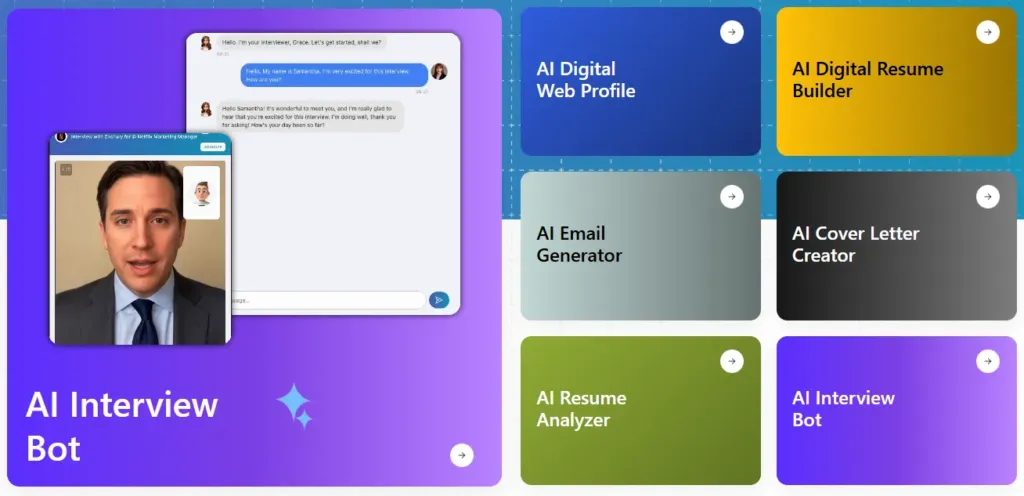
How the RecruitEye Interview Prep Bot Changes Your Preparation
The RecruitEye Interview Prep Bot is built around one core premise: the only way to get ready for an interview is to do the interview, repeatedly, with honest feedback after every session.
You begin by pasting the job description you are preparing for. The AI analyzes the role — its requirements, responsibilities, seniority level, and likely interview focus areas — and generates a bank of interview questions tailored to that specific position. These are not generic questions pulled from a static list. They reflect what a hiring manager for that role at that level would actually ask, including behavioral questions, situational questions, competency-based questions, and foundational openers like “Tell me about yourself.”
From there, you choose your practice format. This is where the platform does something that most interview prep tools do not.
Text Mode: Build the Structure First
Text mode is the starting point for most users. You type your answers out, which is the lowest-pressure way to develop the framework for what you want to say. This is where you work on the Present-Past-Future structure, where you train yourself to use STAR instinctively, where you learn to include numbers and outcomes rather than reaching for vague language.
The text format is also useful for people who want to refine a specific answer before practicing it verbally. Write it out, get feedback from the AI, rewrite it, get feedback again. By the time you move to audio or video, the structure is already solid and the content is road-tested. You are not improvising the framework in a more demanding format — you are delivering something you have already refined.
This is the equivalent of a musician writing out the music before performing it. The thinking is done first. The performance draws on preparation, not invention.
Audio Mode: Train Your Voice
Audio mode is where the preparation gets real.
You speak your answers out loud the same way you would in a phone screen interview. The AI evaluates not just what you say but how you say it — your verbal clarity, your pacing, whether your delivery is confident or hesitant, whether you are using STAR naturally or collapsing under the pressure of speaking in real time.
Phone screen interviews remain one of the most common first-round formats across virtually every industry. Recruiters make significant filtering decisions in a 20-to-30-minute call based almost entirely on how you sound and whether your answers are organized. A great answer delivered haltingly or without conviction does not survive a phone screen. Audio mode practice trains exactly the skills that matter in this format.
Many users report that the audio mode reveals things about their delivery they had never noticed before — filler words that appear constantly under pressure, hedging language that undermines otherwise strong answers, trailing off at the end of sentences when the most important words need the most emphasis, rushing through the Result when slowing down would create far more impact.
You cannot hear these things when you rehearse in your head. You can only hear them when you actually speak. Once you hear them, you can fix them. Until then, they persist invisibly and cost you in every interview.
Video Mode: The Full Simulation
Video mode is the complete interview simulation.
Camera on, timed, recorded. This format most directly replicates the video interviews that are now standard in virtually every industry — Zoom first rounds, Microsoft Teams panels, asynchronous video screening tools used by large enterprise employers where you record yourself answering questions and submit the recording for review.
In video mode you are working on everything simultaneously: answer content, verbal delivery, on-screen presence, eye contact with the camera, posture, and the nonverbal signals you are sending to whoever is watching. It is the most demanding format, which is exactly why it produces the most rapid improvement for candidates who use it consistently.
For candidates who have not done extensive video interviewing, this format can be genuinely revelatory. You see yourself the way the interviewer sees you. You notice whether you are looking at the camera or at your own face on the screen. You notice whether your background reads as professional or distracting. You notice whether you look calm and prepared or whether the visual signals contradict what your words are saying.
Eye contact in a video interview means looking at the camera lens, not at the interviewer’s face on your monitor. Most people instinctively look at the face, which reads on the other person’s screen as looking slightly down and away — a subtle but consistent signal of disengagement. You learn to look at the camera only by practicing until it becomes automatic, because it feels unnatural at first and cannot be willed into place in a real interview without prior repetition.
The recommendation from users is to begin with text, progress to audio once the structure feels solid, and then move to video in the final sessions before an important interview. Each format builds on the previous one rather than replacing it.
Understanding the AI Feedback Report
The feedback system is what separates meaningful practice from going through the motions.
After every answer in every format, the Interview Prep Bot generates a detailed performance report. This report evaluates your response against the same criteria that real enterprise hiring managers use — the same dimensions that professional recruiting teams are trained to evaluate.
The report covers STAR structure completeness. Did your answer have all four components, or did you describe the situation and the actions without ever landing on a clear result? Did your Task component explain what you specifically were responsible for, or did it describe a team effort without making your individual role clear?
It scores clarity and conciseness. Were your sentences direct, or were they padded with hedging language? Did you communicate the core idea efficiently, or did you take two minutes to get to a point that could have landed in thirty seconds?
It evaluates specificity. Did you use concrete examples, or did you stay in the abstract? Did you give a number, or did you say “significantly improved”? Vague answers score poorly regardless of how much experience underlies them, because vague answers do not convince interviewers — and interviewers know the difference between candidates who achieved things and candidates who claim they did.
It assesses impact. Would your answer make a hiring manager want to know more, or would it fade into a forgettable list of responses from a long day of interviews? The strongest answers leave the interviewer with a clear mental image of the candidate’s capabilities and accomplishments. Weak answers leave no impression at all.
You do not just receive a score. You receive specific notes on exactly what to fix. If your Action component was underdeveloped, the feedback says so and suggests what to add. If your answer ran too long and lost focus in the second half, the report identifies where the drift began. If you answered a behavioral question without a clear Result, it flags the gap and explains why that matters to recruiters evaluating you against the STAR standard.
Review the feedback alongside your own judgment. Practice explaining your situation, task, action and result using examples that accurately reflect your experience.
Your best answers can be saved to a personal Answer Library. When you nail a response to a particularly challenging question, you save it. You review it before your next interview. You use it as a template for related questions. Over time you build a personal bank of proven answers that you can draw on across multiple interviews rather than improvising under pressure each time.
Difficulty Levels and How to Use Them Strategically
The Interview Prep Bot offers three difficulty levels, and understanding when to use each one is part of what makes consistent practice effective.
Easy mode focuses on foundational questions — the classics that appear in virtually every first-round interview. “Tell me about yourself.” “What is your greatest strength?” “Why are you interested in this role?” These questions feel simple but are answered poorly by most candidates who have never practiced them in a real format. Easy mode is where you build the foundations that everything else depends on.
Medium mode introduces complexity. Behavioral questions become more layered. “Tell me about a time you disagreed with your manager and how you handled it.” “Describe a project where the scope changed significantly and what you did.” “Walk me through a time you had to make a decision with incomplete information.” These require more developed stories and more careful STAR structure. This is where the bulk of your preparation time should go.
Hard mode simulates real recruiter pressure. Follow-up questions probe your answers. The AI pushes back on vague responses the way a sharp interviewer would in a real conversation. “You mentioned you improved the process — what specifically did you change and how did you measure the improvement?” Hard mode tests whether your answers hold up under scrutiny or whether they collapse when challenged. This is the mode that matters most for senior roles and competitive processes.
The strategic approach cycles through all three. Start in Easy mode to establish fluency with foundational answers. Move to Medium for the bulk of your prep. Use Hard mode in your final session before the real interview to stress-test your best answers and find the gaps you did not know were there.
Preparing for Different Interview Formats: Phone, Video, and In-Person
The same answer that works in a video interview does not automatically translate to a phone screen or an in-person conversation. Each format has its own dynamics and requires specific preparation on top of the content foundation.
Phone screen interviews are almost entirely dependent on your voice. The interviewer cannot see you. There is no body language, no eye contact, no physical presence to project confidence through. Everything you communicate travels through the words you choose and how you deliver them. Pacing matters enormously. Speaking slightly slower than you naturally would, allowing brief deliberate pauses after key points, and eliminating filler words are all more consequential in audio-only formats than in any other context.
Audio mode practice in the Interview Prep Bot is specifically designed to build these skills. When the AI evaluates your verbal clarity, your pacing, and your structure in an audio format, it is measuring the things that directly determine your performance in phone screens.
Video interviews have become the dominant first-round format across most industries and most company sizes. Whether it is a live Zoom call with a recruiter or an asynchronous video screen where you record your answers and submit them, the camera adds a layer of complexity that most candidates significantly underestimate until they see themselves on screen for the first time.
Your background matters. Your lighting matters. Whether you are centered in the frame matters. Whether you are looking at the camera or at your own face on the screen matters. None of this is about vanity — it is about what reads as professional and prepared to someone evaluating you through a screen.
Video mode practice is the only way to develop these habits before a real interview. You cannot learn to look at the camera by thinking about it. You learn it by doing it repeatedly until it becomes automatic.
In-person interviews reintroduce the full physical dimension — handshake, posture, the energy in the room, the ability to read and respond to body language in real time. The content preparation transfers directly from your text and audio practice. The in-person layer is built on top of a strong content foundation rather than replacing it.
Regardless of format, the underlying work is the same: know what you want to say, practice saying it in the specific medium you will be using, and refine based on honest feedback.
The Questions That Always Follow Your Opener
Once you have delivered your “Tell me about yourself” answer, the follow-up questions are predictable. Interviewers follow patterns. Here are the six questions to have locked and loaded before every interview, because they will come right after your introduction.
“Walk me through your resume.” This is the expanded version of the opening question. Have a two-to-three-minute version ready that connects your career arc logically and highlights the moments that matter for this specific role. Do not go year by year — tell the story of progression and connect it to where you are now.
“What is your greatest strength?” The answer cannot be a trait alone. “I am a great communicator” is meaningless without a story that proves it. Have one specific, well-structured STAR example ready that demonstrates the strength in action and includes a concrete result.
“What is your greatest weakness?” The interviewer is not looking for performed humility or genuine disqualifying confessions. They want to see self-awareness and a growth orientation. Pick a real but manageable area, describe the specific steps you have taken to address it, and land on the progress you have made.
“Why do you want to work here?” This is where company research pays off directly. Candidates who can name a specific product decision, a recent announcement, a publicly stated value, or a direction articulated in the company’s communications stand out clearly. Generic answers about culture and growth are filler. Specific answers are remembered.
“Tell me about a time you failed.” This is a STAR question with a specific twist. The failure itself matters less than what you learned and what you changed because of it. Structure it fully, own your role in what went wrong clearly, and land on the concrete things that changed as a result.
“Where do you see yourself in five years?” This answer should be ambitious but grounded, and it should connect visibly to the role you are applying for. If the answer sounds like it belongs at a completely different company or career track, the interviewer will reasonably wonder why you are sitting in their chair.
All six of these can be practiced at every difficulty level inside the RecruitEye Interview Prep Bot, with job-specific variations generated from the job description you provide.
The Connection Between Interview Prep and Resume Strength
There is one piece of this that most candidates miss, and it matters more than they realize.
The quality of your interview answers is directly tied to the clarity of your resume. When your resume is built around specific, quantified accomplishments rather than vague responsibilities, you have a bank of real, developed stories to draw from in the interview. When your resume is generic, you have very little ammunition.
This is why the strongest job search strategies combine resume optimization and interview preparation rather than treating them as separate exercises.
If you have not already run your resume through the RecruitEye Resume Analyzer, doing that before starting interview prep is worth the time. The analyzer evaluates your resume across seven dimensions including quantification, impact language, STAR structure in accomplishment statements, ATS keyword match, and skills gaps. The specific improvements it surfaces become the raw material for your interview stories.
A resume that says “improved sales performance” gives you almost nothing to work with in an interview. A resume that says “increased territory revenue by 38 percent over 18 months by restructuring the account segmentation model” gives you a fully formed STAR story that you can deliver in 60 seconds. The prep work feeds itself when the underlying material is strong.
How to Build a Practice Schedule Before a Real Interview
The timing of your preparation matters as much as the content. Here is a schedule that works regardless of your timeline.
Seven or more days out: Complete your first text mode session focused entirely on your “Tell me about yourself” answer. Get the structure right, get the specificity right, get the length right. Let the AI feedback guide a second draft. Do this once and let it settle.
Five days out: Move to audio mode. Practice five to six foundational questions including your opener, your strengths and weaknesses, and your “why this company” answer. Listen critically to your delivery. Note the filler words, the pacing gaps, the places where confidence drops.
Three days out: Run a full Medium difficulty session. This is your behavioral practice block. Spend 30 minutes on STAR answers for common behavioral questions covering conflict, failure, leadership, collaboration, and working under pressure. Review the feedback on each answer. Identify the two or three that need the most refinement.
Two days out: Rework the weak answers from your previous session. Practice them again. Then complete your first video mode session — a full simulated interview from opener through behavioral questions. Watch the recording back. Note the eye contact, the posture, the on-screen energy, the moments where delivery breaks down.
One day out: Run one final Hard mode session. Stress-test your best answers. Confirm they hold up under follow-up pressure. Then stop. You will not get significantly better in the final 24 hours, and over-practicing the day before generates more anxiety than improvement. Review your Answer Library, get a good night’s sleep, and trust the preparation you have already done.
What Real Confidence in an Interview Actually Comes From
A lot of interview advice talks about confidence as though it is a personality trait — something you either have or develop through mindset work and positive self-talk.
That is not how it works.
Confidence in interview settings comes from one thing: preparation. Specifically, from knowing that you have practiced what you are about to do, in the format you are about to do it in, enough times that you are not improvising under pressure when the stakes are highest.
The most confident-sounding candidates are almost never the most naturally outgoing ones. They are the most prepared ones. They have said these answers out loud enough times that the words arrive easily and naturally rather than assembling in pieces while they simultaneously manage their nerves, their eye contact, and whatever was said in the last question.
This is why users of the Interview Prep Bot consistently report 3x more confidence going into real interviews after consistent practice sessions. The confidence is not manufactured through positive thinking. It is earned through repetition with feedback — the same way every other performance skill is built.
There is no shortcut to it. Confidence in interviews is a skill, and like every skill it improves with deliberate, honest practice. The question is not whether you need to practice — every candidate does. The question is whether you practice in a way that gives you honest feedback and forces you to improve, or whether you practice in your head and show up hoping it comes together.
The Bottom Line
“Tell me about yourself” is not a warmup. It is not a formality. It is the first real moment of the interview, and it sets the expectation for every answer that follows.
The candidates who answer it well are not better than you. They are not more naturally gifted communicators. They are more prepared. They have practiced the structure, refined the content, said it out loud in multiple formats, read honest feedback, and adjusted. They walk into the room knowing exactly what they are going to say and how it is going to land.
That preparation is available to you right now.
The RecruitEye Interview Prep Bot gives you job-specific questions built from the actual job description, three practice formats — text, audio, and video — difficulty levels that match your current stage of preparation, and a detailed AI feedback report after every session that tells you exactly what to fix and why it matters.
Your next interviewer is going to ask the question. You already know what it is.
Limited access where no credit card required. All three formats available from day one. Unlimited practice sessions.